
The Theoretical Basis for OXPIP's Work?
Attachment theory:
OXPIP approaches its work with parents and babies on the basis of attachment theory as developed by John Bowlby, Peter Fonagy and others. A baby who is understood and whose needs are met will be securely attached to its parent (this can be either or both parents, or the key caregiver) and will have a basic unconscious expectation that its feelings will be regulated and that its attachment figure will restore its well-being. An insecure child will not feel this.
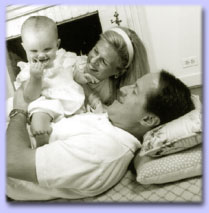 "Regulation" starts with the parent responding to all the baby's physical needs
(such as body temperature or hunger) by touch and feeding and body warmth; the baby cannot regulate these for himself. It expands into the management of the baby's distress or discomfort by the caregiver - soothing the crying baby, leading the baby towards calm by taking down voice levels, or rocking. These behaviours expand into a further level of regulation as the parent helps the toddler to manage negative states of anger and disappointment for increasing periods of time, to name and think about feelings, and to use distraction techniques. If these processes are well managed, the growing child, equipped to manage himself and his own emotional and physiological states, will be confident and flexible in his approach to new experiences.
"Regulation" starts with the parent responding to all the baby's physical needs
(such as body temperature or hunger) by touch and feeding and body warmth; the baby cannot regulate these for himself. It expands into the management of the baby's distress or discomfort by the caregiver - soothing the crying baby, leading the baby towards calm by taking down voice levels, or rocking. These behaviours expand into a further level of regulation as the parent helps the toddler to manage negative states of anger and disappointment for increasing periods of time, to name and think about feelings, and to use distraction techniques. If these processes are well managed, the growing child, equipped to manage himself and his own emotional and physiological states, will be confident and flexible in his approach to new experiences.
Brain research:
The latest scientific research confirms the unique importance of infancy and of the importance of intervening in infancy if things go wrong. Any form of prolonged anxiety or fear in infancy and toddler-hood (caused, for example, by prolonged separation or violence in the family) affects the stress response. The hypothalamus and the amygdala are the parts of the brain most involved in the stress response; they trigger off a complicated biochemical reaction which ends in the production of the stress hormone, cortisol. When stress is chronic, the body produces harmful amounts of cortisol. There is evidence to suggest that the stress response in infants can be put right by extensive physical holding and soothing.
 The development of the pre-frontal cortex (essentially the social brain which manages emotions) is strongly influenced by experiences with the parent in the first 2 years. Positive relationships help this part of the brain to grow by triggering a process which takes beta-endorphin and dopamine into the pre-frontal cortex, enhancing the uptake of glucose, helping new tissue to grow. Different neural pathways are created by positive and negative emotional experiences. Recent longitudinal research in attachment shows that insecurely attached children are far more likely to be disruptive at school, and in adolescence and adulthood (Sroufe 2000a).
What Happens During a Clinical Appointment?
Although clinical practice is based largely on psychodynamic principles, clinicians work flexibly, depending on the needs of the parent and baby. Sessions may begin before the baby is born. A parent may bring a baby who has problems with sleeping, eating or excessive crying. A baby may be apathetic or failing to thrive. A depressed mother may ignore her baby. A mother may be critical of her baby and worried about violent feelings towards it. OXPIP clinicians observe the parent and baby together and help them to build on the strengths in their relationship. This one-to-one observation is the foundation of the therapeutic process. The clinician may video a session with parent and baby and then use the video for a feedback session with the pair.
What Does OXPIP Need from You?
OXPIP, in common with the Child Psychotherapy Trust and the Association for Infant Mental Health, wants to develop a widespread understanding of the importance of the early months and years of life for the development of mental health. OXPIP needs to work within professional partnerships with existing organisations, and to this end has engaged in discussions with local Primary Care Trusts and Social Services Departments. Contact us, through the web site, if you are involved with promoting infant mental health.
 | Healthy Living Centre, Oxford Road, Temple Cowley, Oxford, OX4 2ES |  | (01865) 778034 |  | Privacy statement |